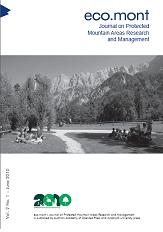
Die Zeitschrift „eco.mont“ – Zeitschrift zur Forschung in Gebirgsschutzgebieten – erschien im Juni 2009 zum ersten Mal. Die Zeitschrift wurde auf Initiative des Netzwerks Alpiner Schutzgebiete (ALPARC), der Schweizer Akademie der Naturwissenschaften (ISCAR), der Österreichischen Akademie für Wissenschaft (ÖAW) und der Universität Innsbruck gegründet. Sie hat das Ziel, Themen zu behandeln, die gleichzeitig Forschung und Verwaltung in und über die Schutzgebiete der Alpen betreffen, ohne dabei andere Gebirgsschutzgebiete Europas oder anderswo auszuschließen. Diese neue Zeitschrift richtet sich an ein Publikum von Wissenschaftlern der verschiedensten Fachbereiche, an die Verwalter von Schutzgebieten und an alle sonstigen Interessierten, Praktiker, Besucher, Lehrpersonal etc. einbegriffen. Die Zeitschrift veröffentlicht begutachtete Beiträge auf Englisch von Autoren, die Fragen der Gebirgsschutzgebieten und deren Verwaltung forschen. Sie erscheint zweimal pro Jahr, auf der Basis der gemeinsamen Anstrengungen des Verlags der Österreichischen Akademie der Wissenschaften, der für die digitale Fassung verantwortlich ist, und der Presse der Universität Innsbruck, verantwortlich für die gedruckte Fassung.
|
eco.mont
ISSN 2073-106X
Print Edition
ISSN 2073-1558
Online Edition
ISBN 978-3-7001-6871-3
Online Edition

|
Send or fax to your local bookseller or to:
Verlag der Österreichischen Akademie der Wissenschaften
Austrian Academy of Sciences Press
A-1011 Wien, Dr. Ignaz Seipel-Platz 2,
Tel. +43-1-515 81/DW 3420, Fax +43-1-515 81/DW 3400
https://verlag.oeaw.ac.at, e-mail: bestellung.verlag@oeaw.ac.at
UID-Nr.: ATU 16251605, FN 71839x Handelsgericht Wien, DVR: 0096385
Bitte senden Sie mir
Please send me |
|
Exemplar(e) der genannten Publikation
copy(ies) of the publication overleaf |
NAME
|
ADRESSE / ADDRESS
|
ORT / CITY
|
LAND / COUNTRY
ZAHLUNGSMETHODE / METHOD OF PAYMENT
Visa Euro / Master American Express
|
NUMMER
|
Ablaufdatum / Expiry date:
I will send a cheque
Vorausrechnung / Send me a proforma invoice
|
|