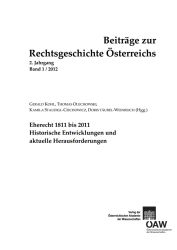
• Gerald Kohl - Thomas Olechowski - Kamila Staudigl‐Ciechowicz - Doris Täubel‐Weinreich (Hg.)

Beiträge zur Rechtsgeschichte Österreichs 1 / 2012

Eherecht 1811 bis 2011 - Historische Entwicklungen und aktuelle Herausforderungen

Bild

Thomas Olechowski
ist ao. Professor an der Universität Wien und wirkliches Mitglied der Österreichischen Akademie der Wissenschaften.


ISSN 2221-8890 Print Edition
ISSN 2224-4905 Online Edition
ISBN 978-3-7001-7314-4 Print Edition
ISBN 978-3-7001-7344-1 Online Edition

doi: https://doi.org/10.1553/BRGOE2012-1
Beiträge zur Rechtsgeschichte Österreichs 2012/1 
2012,   232 Seiten, 30x21cm, broschiert
€  59,00   

Themen dieses Bandes:

Eherecht in einer sich wandelnden Gesellschaft - Historische und aktuelle Entwicklungen des Eheschließungsrechtes - Eherecht und Staatsbürgerschaft - Rechtstatsachen der Ehe - Historische und aktuelle Entwicklungen des Ehescheidungsrechtes

…

Verlag der Österreichischen Akademie der Wissenschaften
Austrian Academy of Sciences Press
A-1011 Wien, Dr. Ignaz Seipel-Platz 2
Tel. +43-1-515 81/DW 3420, Fax +43-1-515 81/DW 3400
https://verlag.oeaw.ac.at, e-mail: verlag@oeaw.ac.at

Bestellung/Order


Bild
Beiträge zur Rechtsgeschichte Österreichs 1 / 2012
ISSN 2221-8890
Print Edition
ISSN 2224-4905
Online Edition
ISBN 978-3-7001-7314-4
Print Edition
ISBN 978-3-7001-7344-1
Online Edition


Send or fax to your local bookseller or to:

Verlag der Österreichischen Akademie der Wissenschaften
Austrian Academy of Sciences Press
A-1011 Wien, Dr. Ignaz Seipel-Platz 2,
Tel. +43-1-515 81/DW 3420, Fax +43-1-515 81/DW 3400
https://verlag.oeaw.ac.at, e-mail: bestellung.verlag@oeaw.ac.at
UID-Nr.: ATU 16251605, FN 71839x Handelsgericht Wien, DVR: 0096385

Bitte senden Sie mir
Please send me
 
Exemplar(e) der genannten Publikation
copy(ies) of the publication overleaf


NAME


ADRESSE / ADDRESS


ORT / CITY


LAND / COUNTRY


ZAHLUNGSMETHODE / METHOD OF PAYMENT
    Visa     Euro / Master     American Express


NUMMER

Ablaufdatum / Expiry date:  

    I will send a cheque           Vorausrechnung / Send me a proforma invoice
 
DATUM, UNTERSCHRIFT / DATE, SIGNATURE

BANK AUSTRIA CREDITANSTALT, WIEN (IBAN AT04 1100 0006 2280 0100, BIC BKAUATWW), DEUTSCHE BANK MÜNCHEN (IBAN DE16 7007 0024 0238 8270 00, BIC DEUTDEDBMUC)
Bild

Zwangsverheiratung im sozialwissenschaftlichen und öffentlich‐politischen Diskurs

    Melanie Goisauf, Rossalina Latcheva

Beiträge zur Rechtsgeschichte Österreichs 1 / 2012, pp. 81-88, 2012/08/02

Eherecht 1811 bis 2011 - Historische Entwicklungen und aktuelle Herausforderungen

doi: 10.1553/BRGOE2012-1s81

€  59,00 

incl. VAT

PDF
X
BibTEX-Export:

X
EndNote/Zotero-Export:

X
RIS-Export:

X 
Researchgate-Export (COinS)

Permanent QR-Code

doi:10.1553/BRGOE2012-1s81


Abstract

In recent years, forced marriage increasingly became a focus of attention in public, political and scientific discourses especially with regard to migration processes and the integration of specific migrant communities. Forced marriage is regarded as a form of domestic violence and a human rights violation. This paper scrutinises popular understandings and common scientific definitions of forced marriage by locating it at the intersection of various forms of social inequality in the context of violence and migration. Based on the analysis of interviews with victims and experts, the study identifies traditionalist practices, misinterpretations of religious obligations, socio-economic deprivation, and experiences of discrimination and marginalisation in the context of immigration as the most relevant factors behind forced marriage. We believe that in order to capture the complex interplay of causes and effects of forced marriage one needs a multifaceted approach which 1) questions the existing public and political discourses on e.g. the so called ‘harmful traditional practices’, 2) evaluates the existing intervention and prevention measures, the legal instruments and their implementation (e.g. the Austrian violence protection act or the international trend to raise age limits for marriages with non-European citizens) and 3) continually contrasts these with the experiences of victims and the views of experts.