Liat NAEH
is a Research Associate at the Archaeology Centre, University of Toronto
Dana BROSTOWSKY GILBOA
is an independent scholar.
|
 |
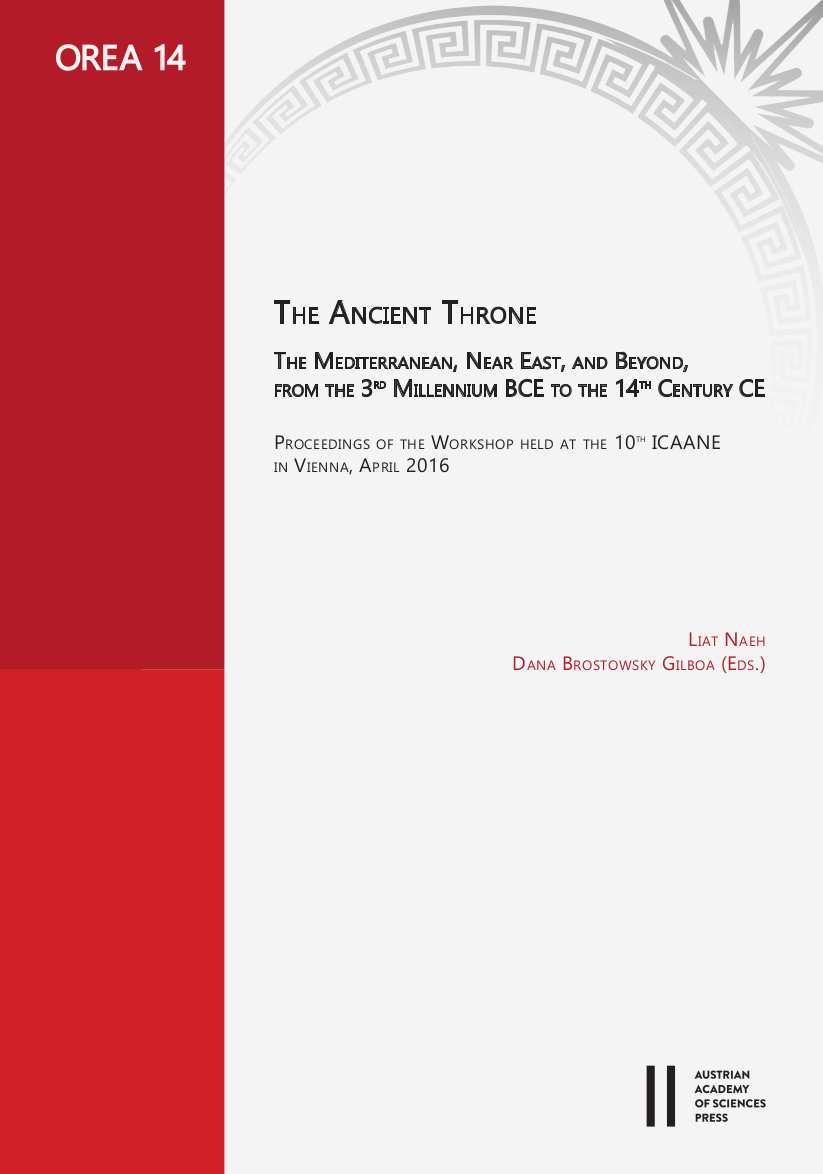
The volume features studies focusing on specific thrones known from historical texts, artistic depictions or excavations, or that offer an overview of the role of thrones from as early as ancient Mesopotamia in the 3rd millennium BCE to as late as Iran and China in the 14th century CE. Its diverse articles all present thrones as a meaningful category of material culture, one that may inspire both inter-cultural and intra-cultural insights on how types of chairs may embody or induce notions of kingship and a range of concepts pertaining to the religious, ideological, and social spheres.
…
Der Band enthält Studien, die sich auf bestimmte Throne konzentrieren, die aus historischen Texten, künstlerischen Darstellungen oder Ausgrabungen bekannt sind. Sie bieten einen Überblick über die Rolle von Thronen vom alten Mesopotamien im 3. Jtd v. Chr. bis hin zum Iran und China im 14. Jhd. n. Chr. Die Beiträge stellen Throne als eine bedeutungsvolle Form materieller Kultur vor, die sowohl inter- als auch intrakulturelle Einblicke liefert, wie Stuhltypen Vorstellungen von Königtum und eine Reihe von Konzepten im religiösen, ideologischen und sozialen Bereich verkörpern.
|