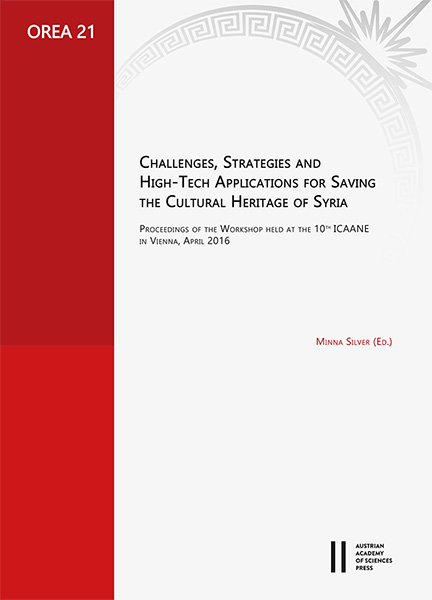
• Minna SILVER (Hg.)

Challenges, Strategies and High-Tech Applications for Saving the Cultural Heritage of Syria

Proceedings of the Workshop held at the 10th ICAANE in Vienna, April 2016

Bild

Minna Silver
is Adjunct Professor in Near Eastern Archaeology at the University of Oulu, Finland


Syria has struggled and been divided by a civil war for over a decade. Cultural heritage is part of human identity and needs to be protected and preserved for the sake of the Syrians and the international community alike. Memories of places and artefacts, social connection and peace can be built on heritage that is common and can be shared. This volume is based on the CIPA workshop organised during the 10th ICAANE held in Vienna in April 2016. The contributions collected therein discuss present challenges in the region and provide an overview of strategies and applications to use various techniques and methods to record and document heritage of Syria, also offering possible prospects for the future.

…

Seit mehr als einem Jahrzehnt ringt Syrien mit einem verheerenden Bürgerkrieg. Die Bewahrung des kulturellen Erbes als Teil der menschlichen Identität und dessen Schutz im Interesse der Syrer:innen und der internationalen Gemeinschaft trägt dazu bei, die Erinnerungen an Orte und Artefakte, soziale Verbindungen und Frieden basierend auf einem gemeinsamen Erbe aufzubauen. Der vorliegende von Minna Silver herausgegebene Band basiert auf dem CIPA-Workshop, der während der 10. ICAANE im April 2016 in Wien stattfand. Die darin versammelten Beiträge diskutieren die gegenwärtigen Herausforderungen in der Region und geben einen Überblick über Strategien und Anwendungen zur Nutzung verschiedener Techniken und Methoden zur Erfassung und Dokumentation des syrischen Erbes und bieten somit auch mögliche Perspektiven für die Zukunft.

Verlag der Österreichischen Akademie der Wissenschaften
Austrian Academy of Sciences Press
A-1011 Wien, Dr. Ignaz Seipel-Platz 2
Tel. +43-1-515 81/DW 3420, Fax +43-1-515 81/DW 3400
https://verlag.oeaw.ac.at, e-mail: verlag@oeaw.ac.at

Bestellung/Order


Bild
Challenges, Strategies and High-Tech Applications for Saving the Cultural Heritage of Syria


ISBN 978-3-7001-8374-7
Print Edition
ISBN 978-3-7001-9219-0
Online Edition


Send or fax to your local bookseller or to:

Verlag der Österreichischen Akademie der Wissenschaften
Austrian Academy of Sciences Press
A-1011 Wien, Dr. Ignaz Seipel-Platz 2,
Tel. +43-1-515 81/DW 3420, Fax +43-1-515 81/DW 3400
https://verlag.oeaw.ac.at, e-mail: bestellung.verlag@oeaw.ac.at
UID-Nr.: ATU 16251605, FN 71839x Handelsgericht Wien, DVR: 0096385

Bitte senden Sie mir
Please send me
 
Exemplar(e) der genannten Publikation
copy(ies) of the publication overleaf


NAME


ADRESSE / ADDRESS


ORT / CITY


LAND / COUNTRY


ZAHLUNGSMETHODE / METHOD OF PAYMENT
    Visa     Euro / Master     American Express


NUMMER

Ablaufdatum / Expiry date:  

    I will send a cheque           Vorausrechnung / Send me a proforma invoice
 
DATUM, UNTERSCHRIFT / DATE, SIGNATURE

BANK AUSTRIA CREDITANSTALT, WIEN (IBAN AT04 1100 0006 2280 0100, BIC BKAUATWW), DEUTSCHE BANK MÜNCHEN (IBAN DE16 7007 0024 0238 8270 00, BIC DEUTDEDBMUC)
Bild

Partnership for Safeguarding Cultural Heritage in Syria: Project ANQA

    Samir Abdulac, Elizabeth Lee, Stefan Simon, Mario Santana Quintero

Challenges, Strategies and High-Tech Applications for Saving the Cultural Heritage of Syria, pp. 227-240, 2022/03/24

Proceedings of the Workshop held at the 10th ICAANE in Vienna, April 2016

€  139,– 

incl. VAT
PDF
X
BibTEX-Export:

X
EndNote/Zotero-Export:

X
RIS-Export:

X 
Researchgate-Export (COinS)

Permanent QR-Code

Abstract

The practice of recording and digitising cultural heritage sites on computers has wide acceptance amongconservation professionals. Recently, the massive loss of sites in areas of conflict has highlighted the urgent need forboth documenting heritage sites and training and building the capacity of local stakeholders This process should notbe limited to computerisation, but also includes a meaningful interpretation of sites with respect to their intangiblevalues, which necessitates new tools. Our aim is to use new technologies to create accurate 3D recordings of at-riskheritage sites, to contribute to capacity building in the region, facilitate the transfer of knowledge and spur the creationof permanent architectural inventory units. A specific aim of the project is to develop a new sustainable activity byempowering local professionals with training and tools to continue the documentation work of cultural heritage beyondthe life of our project. It is our hope that Project ANQA should serve as an example of ‘people-centred’ cultural heritagedocumentation in a digital age through an open-access, participatory web platform. Collected data should be accessibleand useful for scholars, professionals, and the wider public with state-of-the-art tools. Project ANQA is supported bythe Arcadia Fund (London, UK) and initially worked through a partnership of ICOMOS, CyArk and Yale University totrain local professionals in documenting at-risk sites in 3D through an interdisciplinary process. It began successfully inSyria thanks to a fruitful local partnership with UNESCO and the DGAM Training sessions were organised in Lebanonwith exercises in photogrammetric and laser capturing 3D data The project included the provision of equipment,as well as computer programs. A first batch of sites in the World Heritage historic city of Damascus was chosenas being representative of the typological variety of urban historic buildings in this city The progress of the localteam was monitored and remote technical support and guidance provided Visual outputs have just been processedProject ANQA represents a new challenge for a professional NGO like ICOMOS as it includes setting up a working,scientific, technical and financial partnership between half a dozen specialised institutions (Arcadia Fund, CyArk,DGAM, ICOMOS, UNESCO, Yale and then Carleton University) based in different countries while also respondingto emergency needs in a war situation, with difficult material and logistical issues. The good results that have beenachieved to date are due to the enthusiasm and dedication of all participants.

Keywords: Syria; 3D; capacity building; heritage at risk; open access; sustainability