Christophe ERISMANN
ist Professor an der Universität Wien in der Abteilung für Byzanzforschung und Modern Greek Studies
Christian GASTGEBER
ist Mitarbeiter in der Abteilung Byzanzforschung des Instituts für Mittelalterforschung der Österreichischen Akademie der Wissenschaften
Johannes PREISER-KAPELLER
ist Mitarbeiter in der Abteilung Byzanzforschung des Instituts für Mittelalterforschung der Österreichischen Akademie der Wissenschaften
Claudia RAPP
ist Professorin am Institut für Byzantinistik und Neogräzistik der Universität Wien und wirkliches Mitglied der Österreichischen Akademie der Wissenschaften
Elisabeth SCHIFFER
ist Mitarbeiterin in der Abteilung Byzanzforschung des Instituts für Mittelalterforschung der Österreichischen Akademie der Wissenschaften
|
 |
ISSN 0378-8660 Print Edition
ISSN 1810-536X Online Edition
ISBN 978-3-7001-9591-7 Print Edition
ISBN 978-3-7001-9592-4 Online Edition
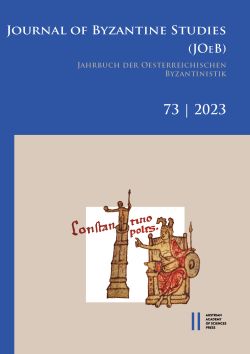
doi: https://doi.org/10.1553/joeb73Jahrbuch der Österreichischen Byzantinistik 73 2024
VIII+339 Seiten, zahlr. Farb- und s/w-Abbildungen, Diagramme 29,7x21cm, broschiert Journal (print) €
145,00
eJournal (PDF) €
116,00
Article (PDF) €
10,00
Die einmal jährlich erscheinende Zeitschrift wurde 1951 als Jahrbuch der Österreichischen Byzantinischen Gesellschaft gegründet; mit dem Wechsel in den Verlag der Österreichischen Akademie der Wissenschaften wurde sie 1973 (ab Band 22) in Jahrbuch der Österreichischen Byzantinistik umbenannt.
Mit Band 68 (2018) führte die Zeitschrift die thematische Bündelung von Themen in Cluster ein.
Aufgrund von Kriterien der Indizierung erscheint die Zeitschrift seit 2021 (Band 71) mit dem Doppeltitel Journal of Byzantine Studies (JOeB) / Jahrbuch der Österreichischen Byzantinistik. Inhaltlich umfasst die Zeitschrift Beiträge jedweder wissenschaftlichen Fokussierung auf Byzanz und seine Nachbarn.
Band 73 enthält 12 Beiträge, die sich mit historischen und philologischen Fragestellungen beschäftigen. Erste Ergebnisse eines Schwerpunktes zu dem Gelehrten Photios sind in den Arbeiten von F. Ronconi und C. Schiano veröffentlicht. Der byzantinischen Historiographie widmen sich drei Beiträge zur griechischen Bearbeitung des Ammianus Marcellinus (W. Treadgold), zu Menander Protector (F. Rance) und zu Georgios Synkellos (P. Varona). Ch. Simelidis greift u.a. eine in JOEB 69 initiierte Diskussion zu Symeon Metaphrastes mit neuen Ergebnissen auf. Neue Texteditionen mit Kommentaren werden zu Barlaam von Kalabrien (F. Acerbi, S. Di Mambro), zum ersten papyrologischen Beleg der Briefsammlung des Isidor von Pelusium (M. Thoma, A. Papathomas) sowie zu einer elegischen Klage eines Gelehrten (M. Tomadaki) präsentiert. Die Epigraphik ist mit einem inschriftlichen Epigramm des Theodoros Prodromos in Naxos vertreten (Th. Konstantellou). Den historischen Schwerpunkt runden zwei Beiträge zur Zwangsarbeit in kaiserlichen Textilwerkstätten (A. C. Kelley) und zur Frage des Fastens (D. Krausmüller) ab. Rezensionen zu aktuellen Neuerscheinungen beschließen den Band.
|