![]() |
Vienna Yearbook of Population Research 2009
|
![]() |
Verlag der Österreichischen Akademie der Wissenschaften Austrian Academy of Sciences Press
A-1011 Wien, Dr. Ignaz Seipel-Platz 2
Tel. +43-1-515 81/DW 3420, Fax +43-1-515 81/DW 3400 https://verlag.oeaw.ac.at, e-mail: verlag@oeaw.ac.at |
|
||||||||||||||||||||
|
DATUM, UNTERSCHRIFT / DATE, SIGNATURE
BANK AUSTRIA CREDITANSTALT, WIEN (IBAN AT04 1100 0006 2280 0100, BIC BKAUATWW), DEUTSCHE BANK MÜNCHEN (IBAN DE16 7007 0024 0238 8270 00, BIC DEUTDEDBMUC)
|

Vienna Yearbook of Population Research 2009, pp. 217-233, 2000/03/18
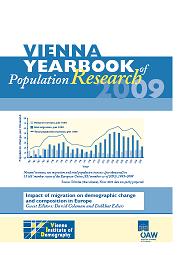
This contribution provides a statistical overview of major migration trends and regional differences in Europe and pays special attention to trends in net migration. During the past decades, Europe saw substantial positive migration gains, which accelerated in the early 2000s. There are large regional differences in net migration: southern Europe, and especially Spain, experienced massive immigration in 2000-2008 while many countries in south-eastern, eastern and central Europe registered migration losses. In total, net migration in Europe amounted to 28.4 million in 1980-2008, of which 22.2 million ‘net migrants’ were reported in European Union (EU) countries. In 2000-2009, the EU population gained almost 15 million through net migration. This number is higher than the total for the previous four decades, making the European Union a more important migration destination than the United States during this period. Recent economic recession put a break on net migration gains in most countries, but preliminary data suggest large differences between countries, with some countries reporting stable or slightly increasing net migration in 2009.
Keywords: Migration Trend; Net Migration; Southern Europe; Spain