
![]() |
Österreichische Zeitschrift für Kunst und Denkmalpflege
|
![]() |
Die „Österreichische Zeitschrift für Kunst und Denkmalpflege“, ÖZKD, geht auf die „Mittheilungen der k. k. Central-Commission zur Erforschung und Erhaltung der Baudenkmale“, Band I erschienen 1856, zurück und wird in der heutigen Form seit 1952 publiziert. Der Schwerpunkt liegt auf den Themen Bauforschung, denkmaltheoretischen Beiträgen und architekturhistorischen Forschungen in Österreich und Europa. Einzelne Ausgaben erläutern die Restaurierung von Denkmalen im restauratorischen Kontext oder berichten über die Ergebnisse von Tagungen und Fachgesprächen. Die ÖZKD gibt damit den aktuellen Diskussions- und Forschungsstand in den Bereichen Denkmalschutz und Denkmalpflege wieder.
|

![]() |
Verlag der Österreichischen Akademie der Wissenschaften Austrian Academy of Sciences Press
A-1011 Wien, Dr. Ignaz Seipel-Platz 2
Tel. +43-1-515 81/DW 3420, Fax +43-1-515 81/DW 3400 https://verlag.oeaw.ac.at, e-mail: verlag@oeaw.ac.at |
|
||||||||||||||||||||
|
DATUM, UNTERSCHRIFT / DATE, SIGNATURE
BANK AUSTRIA CREDITANSTALT, WIEN (IBAN AT04 1100 0006 2280 0100, BIC BKAUATWW), DEUTSCHE BANK MÜNCHEN (IBAN DE16 7007 0024 0238 8270 00, BIC DEUTDEDBMUC)
|

ÖZKD LXXIX 2025 Heft 4, pp. 27-31, 2026/04/10
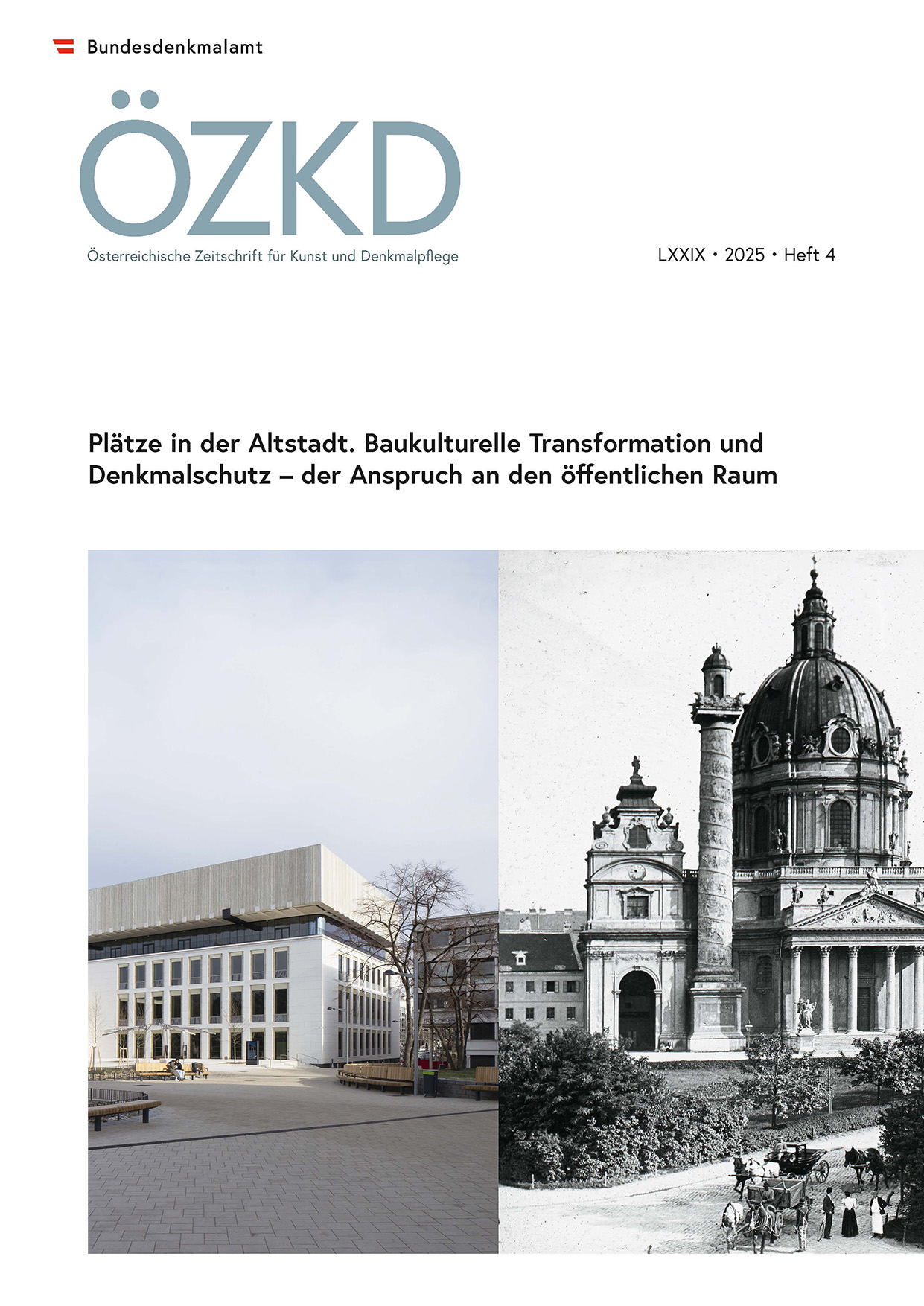
Plätze in der Altstadt. Baukulturelle Transformation und Denkmalschutz – der Anspruch an den öffentlichen Raum
This article addresses urban planning adaptation to environmental change and climate change. Historically, cities have always had to respond to environmental influences in order to remain viable in the long term. The article illustrates this through three examples from Vienna. One example is the regulation of the Wien River between 1894 and 1906, which technically reconceived flood protection through the creation of large retention basins west of the city and thereby opened up new development opportunities within the inner city. The district of Lichten-tal, part of Vienna’s 9th municipal district, also underwent transformations due to repeated flooding, particularly through the raising of street levels and all the associated consequences. The 1905 resolution establishing the Vienna Forest and Meadow Belt not only halted further deforestation and development but also aimed to improve air quality and relieve the growing urban area. Today, climate change represents one of the greatest challenges for cities. This also raises the question of how such measures can be integrated into the historic urban context. If we fail to act, there is ultimately the risk that our cities will become uninhabitable due to increasing stress from extreme heat, heavy rainfall, or other extreme weather events.