
![]() |
Österreichische Zeitschrift für Kunst und Denkmalpflege
|
![]() |
Die „Österreichische Zeitschrift für Kunst und Denkmalpflege“, ÖZKD, geht auf die „Mittheilungen der k. k. Central-Commission zur Erforschung und Erhaltung der Baudenkmale“, Band I erschienen 1856, zurück und wird in der heutigen Form seit 1952 publiziert. Der Schwerpunkt liegt auf den Themen Bauforschung, denkmaltheoretischen Beiträgen und architekturhistorischen Forschungen in Österreich und Europa. Einzelne Ausgaben erläutern die Restaurierung von Denkmalen im restauratorischen Kontext oder berichten über die Ergebnisse von Tagungen und Fachgesprächen. Die ÖZKD gibt damit den aktuellen Diskussions- und Forschungsstand in den Bereichen Denkmalschutz und Denkmalpflege wieder.
|

![]() |
Verlag der Österreichischen Akademie der Wissenschaften Austrian Academy of Sciences Press
A-1011 Wien, Dr. Ignaz Seipel-Platz 2
Tel. +43-1-515 81/DW 3420, Fax +43-1-515 81/DW 3400 https://verlag.oeaw.ac.at, e-mail: verlag@oeaw.ac.at |
|
||||||||||||||||||||
|
DATUM, UNTERSCHRIFT / DATE, SIGNATURE
BANK AUSTRIA CREDITANSTALT, WIEN (IBAN AT04 1100 0006 2280 0100, BIC BKAUATWW), DEUTSCHE BANK MÜNCHEN (IBAN DE16 7007 0024 0238 8270 00, BIC DEUTDEDBMUC)
|

ÖZKD LXXIX 2025 Heft 4, pp. 48-56, 2026/04/10
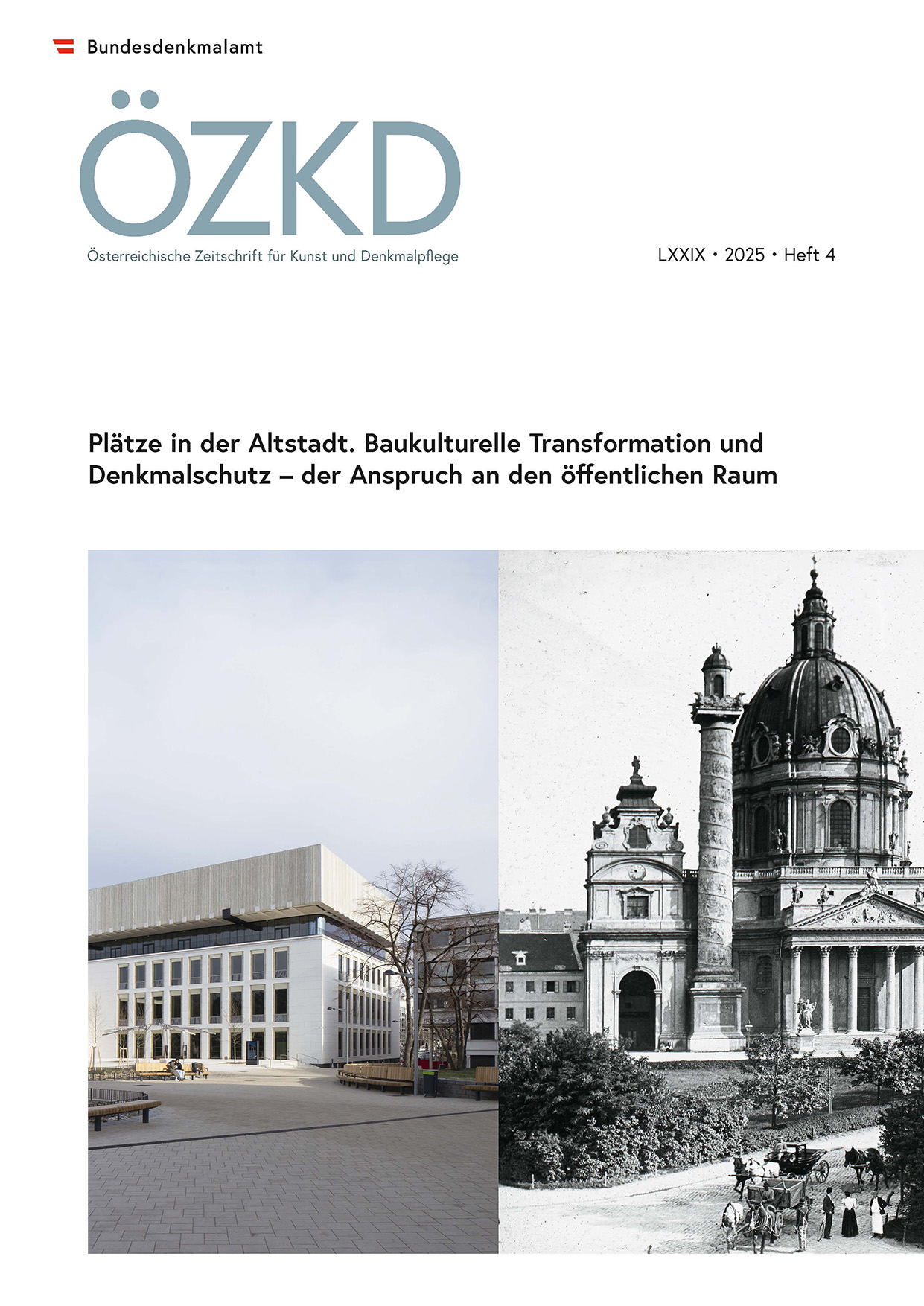
Plätze in der Altstadt. Baukulturelle Transformation und Denkmalschutz – der Anspruch an den öffentlichen Raum
Squares of the 20th century in Austria can embody multiple layers of meaning as monuments: they function not only as designed elements but also as spaces of public life, social participation, and democratic experience. While squares of the interwar period served as expressions of social reform and healthy living, under totalitarian regimes they could also become instruments of surveillance and terror. In the post-war period, spaces emerged whose open areas were deliberately designed to be accessible, promoting equal use and community. By con-trast, the congress centre in Bad Gastein illustrates the utopian dimension of square design. Later postmodern squares are characterised primarily by staging, narration, and symbolic coding, with public space increasingly becoming a stage. Despite their differing historical contexts, all the examples discussed share dimensions of participation, accessibility, and experiential meaning, highlighting open spaces as central bearers of monument properties. Protected squares in Austria reflect the societal ideals and political systems of their time of origin. Their designation as heritage sites underscores that open spaces are not merely architectural complements but can themselves be carriers of monument values.